
Architectural Storytelling: Transforming High-End Properties into Iconic Media Assets
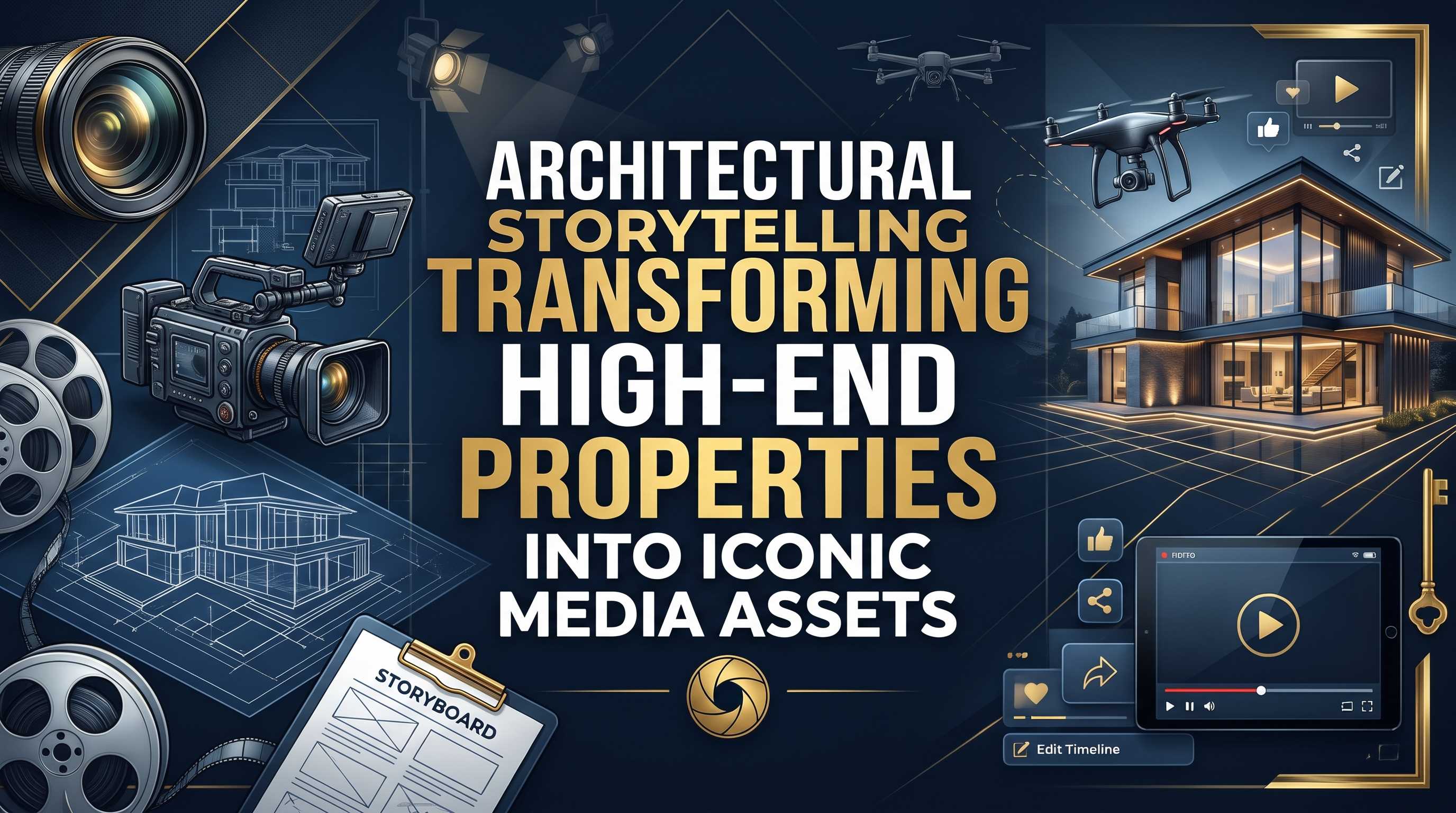
In the ultra-luxury real estate sector, traditional property marketing, historically reliant on wide-angle static photos, floor plans, and technical specs, fails to engage modern High-Net-Worth Individuals (HNWIs). High-end homes are rarely acquired merely to satisfy functional space requirements; luxury transactions are driven by emotional resonance, identity projection, status signaling, and lifestyle alignment.
Architectural storytelling reframes physical real estate as an experiential media asset. Instead of merely documenting physical boundaries, it constructs a narrative arc around the home, translating sightlines, natural light modulation, material transitions, and spatial proportions into dynamic emotional beats. Cognitive research demonstrates that visual media viewers retain approximately 95% of a message conveyed through video, compared to just 10% for static text. Elevating a property from a static listing to a narrative-driven visual asset builds emotional equity, accelerates sales velocity, and commands a distinct value premium.
1. Beyond the MLS Photo Grid: Cinema & Spatial Computing
Visual media has evolved far beyond basic walkthrough videos. To engage ultra-wealthy prospects, visual assets must meet production standards comparable to fine-art films and editorial publications.
-
Director-Led Cinematic Films: Utilizing cinematic cameras, artistic lighting, and custom sound design, director-led short films establish an emotional narrative. A notable case study is SERHANT. Studios' Through The Lens Of series, which created short films tailored to listing personalities using directorial styles (such as Wes Anderson for symmetrical modern estates or Stanley Kubrick for atmospheric townhouses). This directorial approach generated over 329,000 targeted social impressions, marketed $65.65 million in luxury inventory across five short films, and put over $31 million in luxury real estate under contract.
-
3D Gaussian Splatting (3DGS): Moving beyond rigid, point-to-point 360-degree photo scans, 3DGS represents 3D environments using millions of semi-transparent ellipsoids ("splats") encoded with light physics. This enables fluid, photorealistic, continuous walkthroughs with accurate light reflections that buyers can explore directly in their WebGPU-enabled web browser without downloading an app.
-
Twilight & Drone Scenography: Photographing during twilight leverages the contrast between warm indoor lighting and cool evening skies, increasing digital click-through rates by 22% to 31% over daytime photos. Aerial drone footage contextualizes acreage, coastal access, and topography, while generative spatial AI illustrates completed interior possibilities for unbuilt or pre-construction spaces.
2. Comparing Traditional vs. Storytelling Marketing Approaches
To understand how architectural storytelling transforms property perception, consider how key marketing dimensions compare:
-
Core Messaging: Traditional listings focus on dimensional attributes, room counts, and square footage, whereas architectural storytelling emphasizes lived experience, emotional narrative, and design heritage.
-
Visual Media Assets: Traditional marketing relies on static photos and basic floor plans, while storytelling deploys cinematic short films, 3D Gaussian Splats, and twilight drone scenography.
-
Buyer Perception: Traditional buyers evaluate the home as a commodity based on price-per-square-foot, while storytelling buyers experience the property as an irreplaceable, highly curated lifestyle artifact.
-
Cognitive Mechanics: Traditional approaches trigger feature-checklist logic, whereas storytelling inspires emotion-driven desire and identity alignment.
-
Distribution Strategy: Traditional listings depend on passive portal syndication, while storytelling utilizes active, targeted omnipresence across Connected TV, programmatic display, and private wealth networks.
-
Financial Realization: Traditional listings face price negotiations and discounting, whereas narrative positioning commands an emotional visual premium of 5% to 20% on the final sale price.
3. Highlighting Custom Craftsmanship
A successful campaign frames the buyer as the protagonist of the story. Visual sequences guide perception through a natural journey: arrival and threshold entry, open communal spaces, and private sanctuaries.
Storytelling highlights the home's material design provenance, whether hand-carved stone, imported European millwork, or custom steel architecture, by capturing texture, warmth, and light shifts throughout the day. Staging is curated with authentic collectible furniture, original artwork, and warm lighting to create a refined, lived-in atmosphere rather than an artificial showroom.
4. Targeted Digital Omnipresence & Multi-Channel Distribution
Producing cinema-grade assets yields limited return if distribution is restricted to passive web portals. Luxury distribution requires an active, targeted digital omnipresence strategy designed to reach distinct financial tiers:
-
Ultra-High-Net-Worth (UHNW) Segment ($30M+ Net Worth): UHNW buyers prioritize privacy, discretion, multigenerational legacy, and exclusivity. Marketing directed at this tier must remain understated and non-transactional. Reaching this audience requires account-based marketing directed at wealth advisors, direct outreach to family offices, and hyper-targeted geofencing.
-
Very-High-Net-Worth (VHNW) & HNW Segment ($1M–$30M Net Worth): These buyers respond to aspirational lifestyle content backed by clear value propositions. Key channels include Meta, Instagram, Connected TV (CTV), and programmatic placements adjacent to premium editorial content.
5. Financial Performance and Measurable ROI
Allocating capital toward high-end media is an investment designed to maximize equity and minimize holding costs. Luxury developers and sellers typically allocate 1% to 4% of a property's target value to marketing infrastructure across the project lifecycle.
This investment yields concrete returns across key metrics:
-
Inquiry Generation: Listings featuring cinema-grade video and 3D walkthroughs generate up to 403% more qualified inquiries than photo-only listings.
-
Days on Market (DOM): Narrative media strategies reduce DOM by up to 40%, cutting ongoing mortgage, tax, insurance, and maintenance costs.
-
Final Sale Price Lift: Visually optimized properties achieve a 5% to 20% higher final price. On a $10,000,000 property, a 5% lift delivers an additional $500,000 in net equity, providing a massive return on a $100,000 media budget.
-
Remote Transactions: High-fidelity media engines empower global buyers to execute multi-million-dollar contracts remotely, as demonstrated by documented sales of a $38 million property driven by social media and a $57 million townhouse closed entirely remotely.